For developers

Tools we build for building.

Most of what we make for our own work is open source. It starts with Karmashala, where we run our coding agents every day.

Karmashala कर्मशाला

Open source · Apache-2.0

An agent development environment for Claude Code, Codex and Antigravity.

One Flutter app that runs coding-agent CLIs on your desktop, on a server, or both, and follows them from your phone. Windows is the primary target; Windows, macOS, Linux and Android builds are attached to every release.

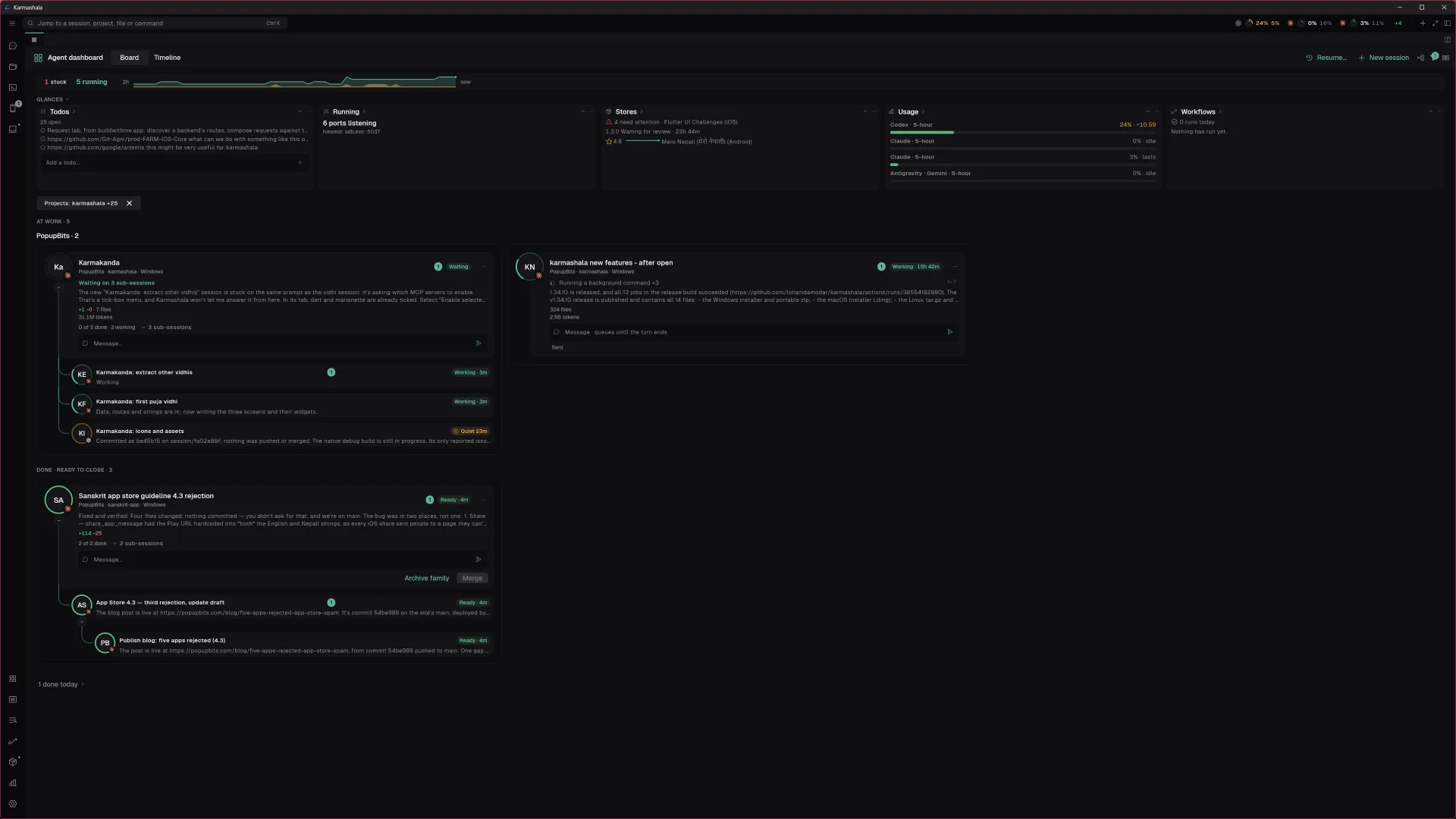
Karmashala's agent dashboard on Windows: running and finished sessions grouped by project with their sub-sessions, and glances for todos, listening ports, store reviews and agent usage limits.
  • Claude Code, Codex and Antigravity

    Each driven through its own protocol, plus any agent that speaks ACP. Sessions started outside the app are imported.

  • Terminals and chat

    Every session is an embedded terminal or a chat view of the same conversation, in split, tabbed groups that survive a restart.

  • Sessions that start sessions

    An agent can start sub-sessions on any agent and model, which report back when they finish.

  • Editor, files and checkpoints

    Edit files in tabs, browse any environment, and roll back to a checkpoint taken every turn.

  • Anywhere the work is

    This machine, a WSL distribution or an SSH host. The headless server keeps sessions running; follow them from your phone.

  • Device, browser and MCP

    Device and browser tooling for agents, and an MCP server of Karmashala’s own.

Coding agents

agent_cli

Dart package

Open source · MIT

Use the coding agents already on a machine as an LLM backend.

Finds and drives the AI coding CLIs already installed, Claude Code, Codex and Gemini CLI, on the host and inside WSL. Someone using one has already signed in, so an app can use it with no API key. Claude Code and Codex are verified end to end; Gemini CLI follows its documented interface and has not been run.

The README states the cost: seconds to the first word through a coding CLI, against milliseconds from a local llama.cpp server.
Flutter

Kickstand

Starter kit · Android, iOS, Web

Paid

A Flutter starter kit for Appwrite: auth, data, paywall and i18n, ready to go.

A production-ready Flutter starter: onboarding, email and guest sign-in, account deletion, a store-ready paywall, settings, English and Spanish, 45 tests and CI. It runs offline in demo mode before you configure anything, and you rebrand it from one file. Solo licence for one developer, Team for up to 10. Checkout is by Stripe, and within 24 hours you get an invitation to the private repository on GitHub.

beej

CLI

Open source · MIT

Plant a new Flutter app from one command.

बीज, a seed: a Dart CLI that generates a complete, buildable Flutter project from the stack every Popup Bits app uses: material_ui, Riverpod 3, English and Nepali localisation, a working theme and settings, and the About screens wired in. It prompts a person, or takes a spec file and publishes a JSON Schema for agents to write against. A generated matrix runs flutter analyze and flutter test on every combination it can produce.

Speech, on your own machine

Dictation

App · Windows

Open source · MIT

Hold a hotkey, speak, and the words are typed where your cursor is.

Local, offline speech recognition on Windows, in pure Dart over Win32: no Flutter and no cloud. It compiles to a small exe, and every release has an installer and a portable zip.

The code is MIT. Speech models are never bundled: they download from their publishers, under their own licences, and some of those are not open source. The licence is shown before anything downloads.

voice-models

Dart package

Open source · MIT

One shared store for speech models, downloaded once per machine.

Speech models are hundreds of megabytes each, and several apps need the same ones. voice-models keeps them in one place per machine, checks every download before using it, and records each model’s upstream source and licence.

The code is MIT. Speech models are never bundled: they download from their publishers, under their own licences, and some of those are not open source. The licence is shown before anything downloads.

speech-pipeline

Dart package

Open source · MIT

Streaming speech-to-speech in Dart: VAD, STT, LLM, TTS.

A voice assistant pipeline built on Dart isolates and streams. Voice detection, recognition and synthesis run locally through sherpa-onnx, a second path answers in a cloned voice, and the language model can be local (llama.cpp, Ollama) or any of a catalogue of cloud providers. English, Nepali and Sanskrit.

The code is MIT. Speech models are never bundled: they download from their publishers, under their own licences, and some of those are not open source. The licence is shown before anything downloads.

Voicelab

App

Open source · MIT

A Flutter client for speech-pipeline.

A Flutter app that runs speech-pipeline, generated with beej. Builds are attached to its GitHub releases.

Desktop and devices

SSHetu

App · Android, Windows, macOS, Linux

Open source · MIT

SSH client, terminal, SFTP and tunnels for every device.

SSHetu keeps your servers in one place and connects to them from a phone, a tablet or a desktop — a real terminal, an SFTP file browser, port forwarding, and SSH keys generated on the device. No backend and no account: hosts and keys stay in the OS keychain, move to a second device over your own network, and back up to an encrypted file you keep. Named from सेतु (setu), a bridge. Free and open source (MIT).

Tilepad

App · Windows, Linux, Android

Open source · BSD-3-Clause

An open-source alternative to Touch Portal.

Build your own touch deck — a Tilepad server runs on your desktop while the client on your phone gives you a fully customizable grid of tiles for shortcuts, media controls, and macros. Cross-platform, free, and BSD-3 licensed.

Found a bug, or want a feature?

Open an issue on the tool’s GitHub repository. For anything else, write to us.